
Tags
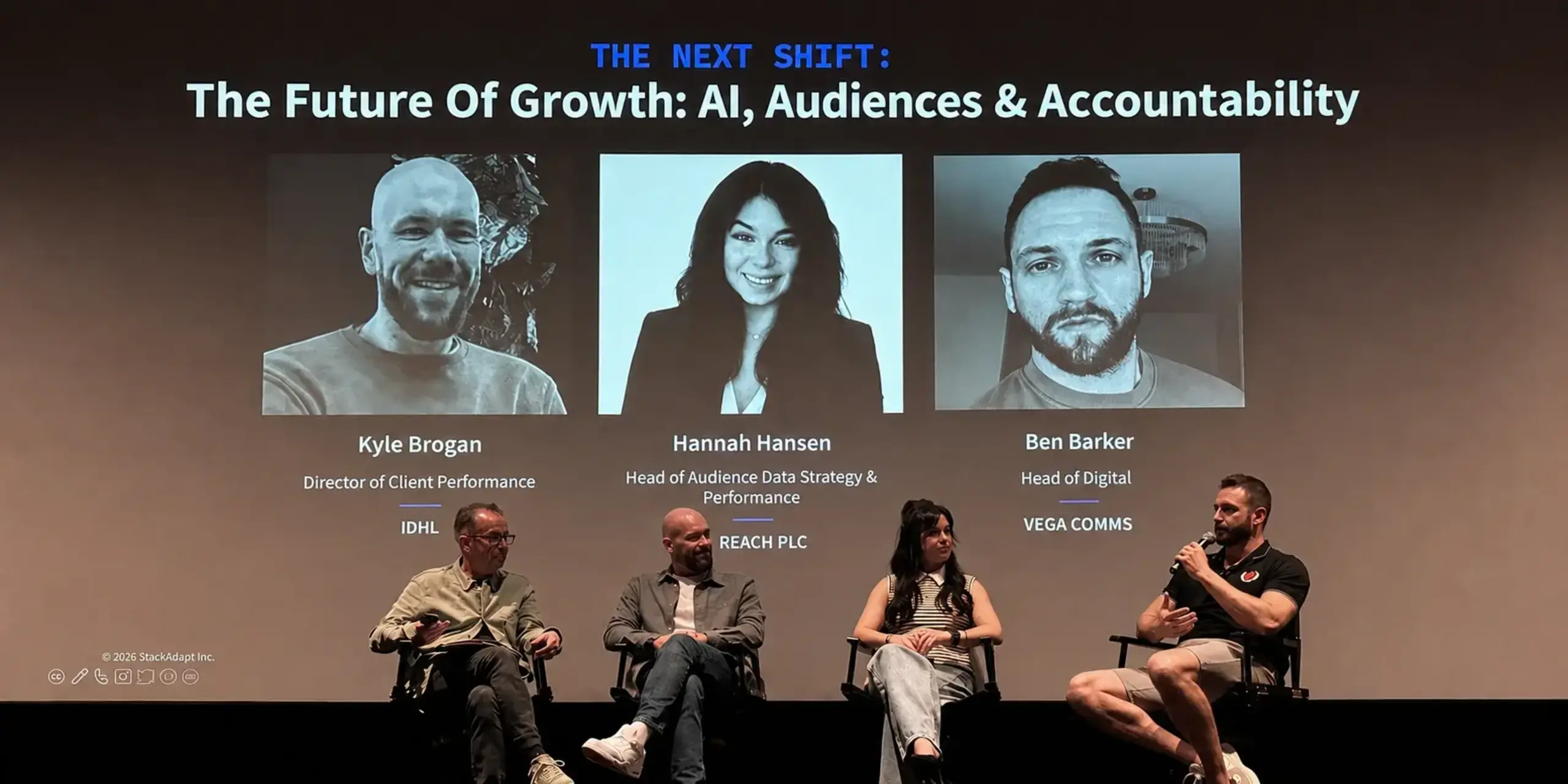
At StackAdapt Connect Manchester, our Director of Client Performance, Kyle Brogan, joined a panel exploring where brands are placing their bets for the second half of 2026.
The agenda covered familiar themes: AI adoption, social commerce, CTV, attribution, and Q4 planning. But the conversation kept returning to the same challenge: customer behaviour is changing faster than the way teams organise, measure, and optimise marketing.
An audience poll demonstrated this change: almost every hand in the room went up when attendees were asked whether they had used ChatGPT for work that week. The response was similar when asked who had used it instead of Google.
Discovery habits have shifted. The bigger question is whether planning, measurement, and investment decisions are evolving quickly enough to keep up.
That was the thread running through the discussion, reflecting exactly what we’re seeing across client conversations, too. Less focus should be on reacting to new channels and more on adapting to how customers are discovering and choosing.
Visibility shouldn’t be channel-led
Visibility extends beyond channel performance. It still matters, but it should be looked at alongside presence, credibility, and whether a brand appears in the moments that matter.
As Kyle put it:
“Plans are evolving beyond individual channel strategies. We’re having more conversations around visibility, influence, and how brands show up across different environments, and helping clients navigate outside of those silos.”
That changes what success looks like. Visibility can no longer be treated as something created in one place and converted in another.
Customers rarely discover, research, and decide in one place. Someone might encounter a brand through an AI response, see it again through media, compare options elsewhere, and then convert later.
That’s why last-click measurement leaves bigger blind spots than it used to, leaving an incomplete view of what influenced the decision.
Measurement is moving beyond single-source attribution
As customer journeys fragment, we can’t rely on single-source measurement.
With discovery, consideration, and conversion happening across different environments, it’s harder to explain growth through one channel or one reporting view.
That makes understanding contribution more useful than trying to assign all credit to a single source.
Kyle summarised that challenge:
“There isn’t a silver bullet. The questions to ask would be: did we reach the audience we intended, move customers closer to a decision, and ultimately deliver profitable growth?”
Brand lift studies, search lift, assisted conversions, platform signals, and first-party data all help to build a broader view. None of them explain performance alone; the aim should be to understand what combination of activity created it.
Ben Barker, Head of Digital at Vega Comms, reinforced the point:
“You have to get as many different pieces of evidence as you can and put it all together… Metrics don’t mean much in isolation.”
Referral traffic from ChatGPT is a useful example. On its own, it’s interesting but limited. Combined with broader performance signals, it becomes more useful because it explains whether visibility is translating into action.
Planning is starting earlier
One decision now influences multiple channels, which means planning starts earlier than campaign activation to compensate.
Product feeds are one example. Historically, they may have been treated as a shopping input. Today, the same data supports paid activity, organic shopping, and visibility within newer discovery environments.
That means decisions that once sat inside one team now influence multiple routes to purchase. Instead of asking each channel to deliver its own outcome, planning starts to focus on the shared inputs that make all channels work harder.
Testing earlier, creating more flexibility in budgets, and reducing reliance on rigid channel ownership are key when customer journeys are unpredictable.
Growth is evaluated differently
Growth is harder to explain on a multi-channel journey, but success is still reviewed in silos.
Think about customer acquisition cost in the context of lifetime value – not simply the cost of generating a click or conversion, but the cost of acquiring a valuable customer after all the activity that contributed to that outcome.
That distinction changes how success is measured. The question isn’t so much ‘Which channel delivered this conversion?’, but more ‘What combination of activity created a valuable customer?’.
Channel expertise still matters, but unlocking growth is easier when marketing is evaluated against business outcomes – acquisition, retention, and customer value – rather than isolated channel reports.
For IDHL, that’s where integrated thinking creates value. Search, media, data, UX, analytics, and technology all influence how customers discover and choose. Looking at those together creates a fuller picture of what’s driving growth and makes it easier to focus investment where it matters.
Continue the conversation with IDHL
The themes at StackAdapt Connect reflect questions we’re discussing with clients every day:
- How do you stay visible when discovery is more fragmented?
- How do you measure influence rather than just conversion?
- How do you plan around customer behaviour instead of channel boundaries?
If those questions are coming up in your organisation, we’d love to talk. Get in touch with our team today.


.webp?language=en)

.webp?language=en)