
.webp?language=en)
Tags
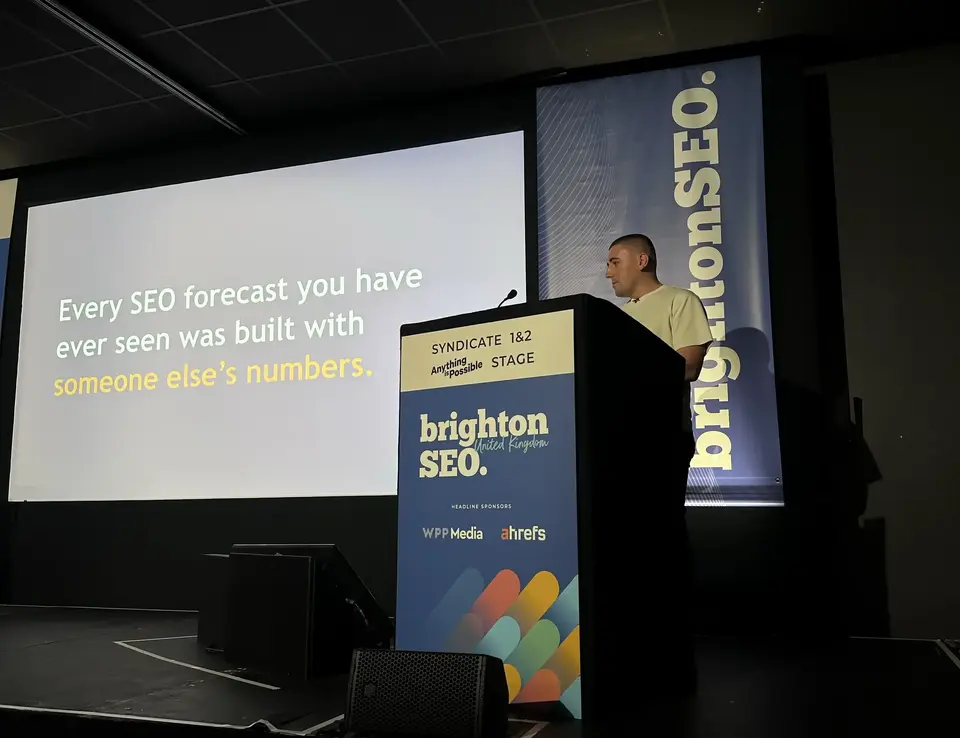
SEO forecasting always had a credibility problem. We regularly walk into meetings with a confident revenue figure, only to reveal that the majority rests on someone else’s search volumes and a sitewide conversion rate with loose connection to the traffic we’re forecasting.
I’ve used that formula before, most of us have. But after 10 years working across software, data and SEO, I’ve learnt that an impressive-looking number is not necessarily a defensible one.
That was the focus of my talk at BrightonSEO: how we can forecast SEO ROI (Return on investment) using data your business already owns, while being upfront about the uncertainty involved.
The problem with SEO forecasts
The traditional SEO forecasting equation we’re used to seeing:
Search volume x CTR x conversion rate x average order value
It’s reassuringly tidy, but three of those four numbers often come from outside the business.
Third-party search volume is an average, published click-through rate (CTR) curves combine websites operating across different search engine result pages (SERPs) and sectors, while sitewide conversion rates blend brand, commercial and informational traffic into one percentage. Only average order value usually comes directly from the organisation making the investment. What marketers end up presenting is a forecast built largely on somebody else’s data.
Introducing the GVO model
Another digital marketing acronym is incoming. My alternative, the GVO model:
Forecast = Gap x Value x Odds
Each element answers a straightforward commercial question:
- Gap: How many clicks are we not getting yet?
- Value: What is each additional click worth?
- Odds: What is the likelihood of earning them?
Crucially, the model relies on Search Console, GA4 and your own performance history, with no third-party volume estimates or borrowed click-through rate curves involved.
Gap: measuring real opportunity
Most forecasts start with estimated search volume, but I think that’s the wrong place to begin. Instead, Search Console data is a far more reliable indicator of demand than a third-party estimate.
This can be used to build your own CTR curve. Export non-brand queries from Search Console, group them by ranking position and calculate the average CTR for each position to create a curve based on your brand’s website, audience and SERPs.
Why does this matter?
In the example I shared at BrightonSEO, the commonly used industry CTR curve suggested a position-three ranking should drive an 11% CTR. The site’s actual CTR at position three was just 6.1% so the forecasting with the industry figure would have overstated performance. Even before any extra calculations were made.
Value: the worth of a click
Once an extra click is available, you need to understand its value, but it looks different depending on the website.
For eCommerce sites it’s conversion rate and average order value. For those in lead generation, it’s conversion rate and lead value. The key is using the conversion rate of the traffic you’re forecasting, not your overall site average.
If your business doesn't have a defined lead value, your paid search activity can often provide a useful benchmark.
Odds: the missing ingredient
This is the part most SEO forecasts skip. Just because an opportunity exists doesn’t mean you’ll capture it.
Odds = win rate x ramp
Your win rate is based on your own SEO history, looking at how many non-brand queries have previously ranked between position five and ten. That success rate gives you a realistic probability of achieving similar gains in the future.
The there’s the ramp. SEO doesn’t deliver results overnight since rankings build over time as content is discovered and indexed. Historical performance then helps you understand how quickly gains tend to materialise. Combining both creates a forecast that’s grounded in reality rather than ambition.
But what about AI?
AI Overviews and answer engines are changing search behaviour and disrupting the traditional CTR benchmarks we’re used to. That’s precisely why relying on published industry curves is becoming... well, risky.
Your own CTR curve already reflects the reality of today’s SERPs, including AI-generated experiences. By rebuilding it regularly, the model naturally adapts as search evolves.
In fact, the framework works beyond traditional SEO. The inputs may change from impressions to citations, or rankings to share of answers, but the principle remains the same:
Gap x Value x Odds
Achieving the real goal with IDHL
The takeaway from my BrightonSEO talk wasn’t that SEO forecasts can become perfectly accurate. They can’t. It’s that your CMO doesn’t need you to be exact, its credibility they’re looking for. If you’re looking to make a change in your SEO strategy? Get in touch with our experts today to get started.




.webp?language=en)